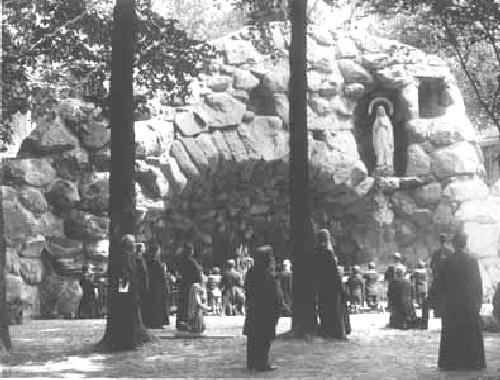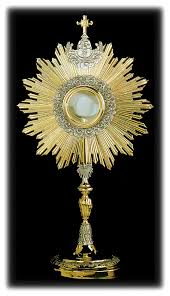
This reliquary contains the remains of Bd. Elizabeth of the Trinity. They are kept within the wall of the Lady Chapel in Église St-Michel, in the heart of Dijon, France. I have knelt here many a time.
Zelo zelatus sum pro Domino Deo exercituum


Notre Dame, our Mother
Tender, strong and true
Proudly in the heavens,
Gleams thy gold and blue.
Glory's mantle cloaks thee
Golden is thy fame,
And our hearts forever,
Praise thee, Notre Dame.
And our hearts forever,
Love thee, Notre Dame.
In the verses above, John of the Cross speaks – seemingly in contradiction – of a solitude that is full of echoes, of a music that cannot be heard. Silence is itself a contradiction. It is at once absence and presence; the path to a place, and the place itself. It is the absence of noise, but it is never empty. The strange fullness of silence alarms us, and it is because its fullness is at times so unbearable that we fill it with noise instead.
My Beloved, the mountains, the solitary wooded valleys,--St John of the Cross
The strange islands, the sonorous rivers,
The whisper of the amorous breezes.
The tranquil night, at the time of the rising of the dawn,
The silent music, the sounding solitude, the supper that recreates and enkindles love.
The eternal silence of these infinite spaces fills me with dread,said Pascal. Yet it is in silence that we hear the things that really matter. Deep silence allows us to listen to our own heart, the place where God speaks to us, the place where God dwells.
Elizabeth Catez was born in 1880 in a French military camp. Twenty-six years later, she lay dead in a Carmelite convent in Dijon, her body so ravaged by Addison’s disease it seemed a skeleton. Most remarkable about this girl was not so much that she had invited such suffering into her life by asking that Christ “fulfill a second humanity” in her; or that she accepted her internal devouring with equanimity (“God is a consuming fire, it is to His action that I submit.”); or that in the midst of her torments she asked, not that her pains would cease, but that God would increase her capacity for suffering. What was most remarkable about Elizabeth of the Trinity is that she was a most ordinary girl from a most ordinary background. Although an intelligent and popular child, she was burdened with a strong will and a fierce temperament. She would go into fits when she did not get her way. In one case, a favorite doll had been borrowed (unbeknownst to her) for use in the parish mission. When she spotted it, she stood up in the middle of the theatre and shouted, “You wicked priest! Give me back my Jeanette!” Other such instances prompted the curate to tell her mother, “With such a temperament, she will be either a demon or an angel.”
She enjoyed clothes and the latest fashions, dressing up to go dancing, and excelled at classical piano. At one point she was nearly engaged to be married. She gave it all up at twenty-one, however, to become the spouse of Christ in the Carmel of Dijon. Three days after entry, a sister wrote a letter to Sr. Geneviève of Lisieux (sibling of St. Thérèse): “a postulant of three days but one who has desired Carmel since the age of seven, Sr. Elizabeth of the Trinity, who will turn out to be a Saint, for she already has remarkable dispositions for that.”